Showing posts with label Sanderling. Show all posts

Friday, 10 January 2020

QEII CP, Linton Lane NR and a wander along the Bay


Jackdaws through the window.


QEII Country Park

Lots of feeders around the lake path so some good numbers of finches and my first Treecreeper of the year.


A very slim looking Kestrel.
I hope it is able to find enough food.


Hooded Crow and Carrion Crow

A quick visit to Linton Lane NR. A good time to visit. Gulls visiting for a quick wash after feeding on the tip. Could always bring in something unusual.


Goldfinch on Teasel


Sanderling


Common Gull


Gorse ...
of course.


Stonechat


Great Spotted Woodpecker


Saturday, 2 November 2019

Lots to See this Week.


CR Sanderling

Ringed 30/04/2018
Sanday, Orkney

Sightings Since
Boulmer 31/12/2018
St Mary's 04/01/2019
Beadnell 12/02/2019
Sanday, Orkney 06/05/2019
Newbiggin 02/11/2019


Patch birds included Cetti's Warblers, 160 Siskin, Handful of Redpolls, Bittern, Marsh Harrier, Buzzard, Sparrowhawk, Peregrine, Treecreepers, GSWs in dunes, Twite and Goldcrests.


Difficult to judge how many are now at this site but 2 males (minimum).


Don't forget to enjoy our resident birds!

Tuesday, 23 January 2018

Winter Birding


Large Thrush flocks along the coast. Mainly Fieldfare but also good numbers of Redwing and Blackbirds.


Bullfinches are clearly more common these days.


This colour-ringed Sanderling was a new find for me at Newbiggin. 

Left Tarsus: Lime Flag, Lime ring, Metal ring.
Right Tarsus: Green ring, Green ring.

I contacted Colin Morse and he replied with details the same day. 
Ringed 30/04/2017
Hine Greenie, Sanday, Orkney, Scotland.


Bar-tailed Godwit


One of four Skylarks on Newbiggin Golf Course.


Grey Plover

Thursday, 27 July 2017

Wednesday, 10 May 2017

Waders


This Sanderling will soon be heading fr Iceland after spending moat of the winter at Newbiggin or close by. Ringed in Iceland 2016


This Godwit (with a Knot) was ringed in 2010 (Dutch Waddensea) and this sighting at Newbiggin is the first since then. This is pretty amazing since it has so many colour rings on?


This Whimbrel was also at Newbiggin and looked fantastic without any 'bling'.

Thursday, 26 January 2017

Sanderling News


Same bird above and below!

It is not often that you get the chance to see the transformation from Summer to Winter plumage in the same bird, but here you can.
The bird above was ringed 22/05/2016 near Reykjavik (Iceland).
Photographed (Top) Chevington 09/08/2016
Photographed (Bottom) Newbiggin 04/01/2017


This bird (above and below) was ringed at Griend (Netherlands) 06/08/2016. It was observed many times in this area until 27/09/2016. The next observation was (photographs) 25/01/2017 at Newbggin.


The last bird (above) was ringed near Reykjavik (Iceland) 17/05/2016. The next observation was at Whitburn (by RA) 11/11/2016 and then photographed by me at Newbiggin 25/01/2017.

Sunday, 8 January 2017

To Ring or Not to Ring?


Colour rings are easy to read in the field and with photographs and quick replies the information is useful and very interesting.


Likewise these coded rings are probably better although good photos are often essential to read the code easily. Only one ring required!

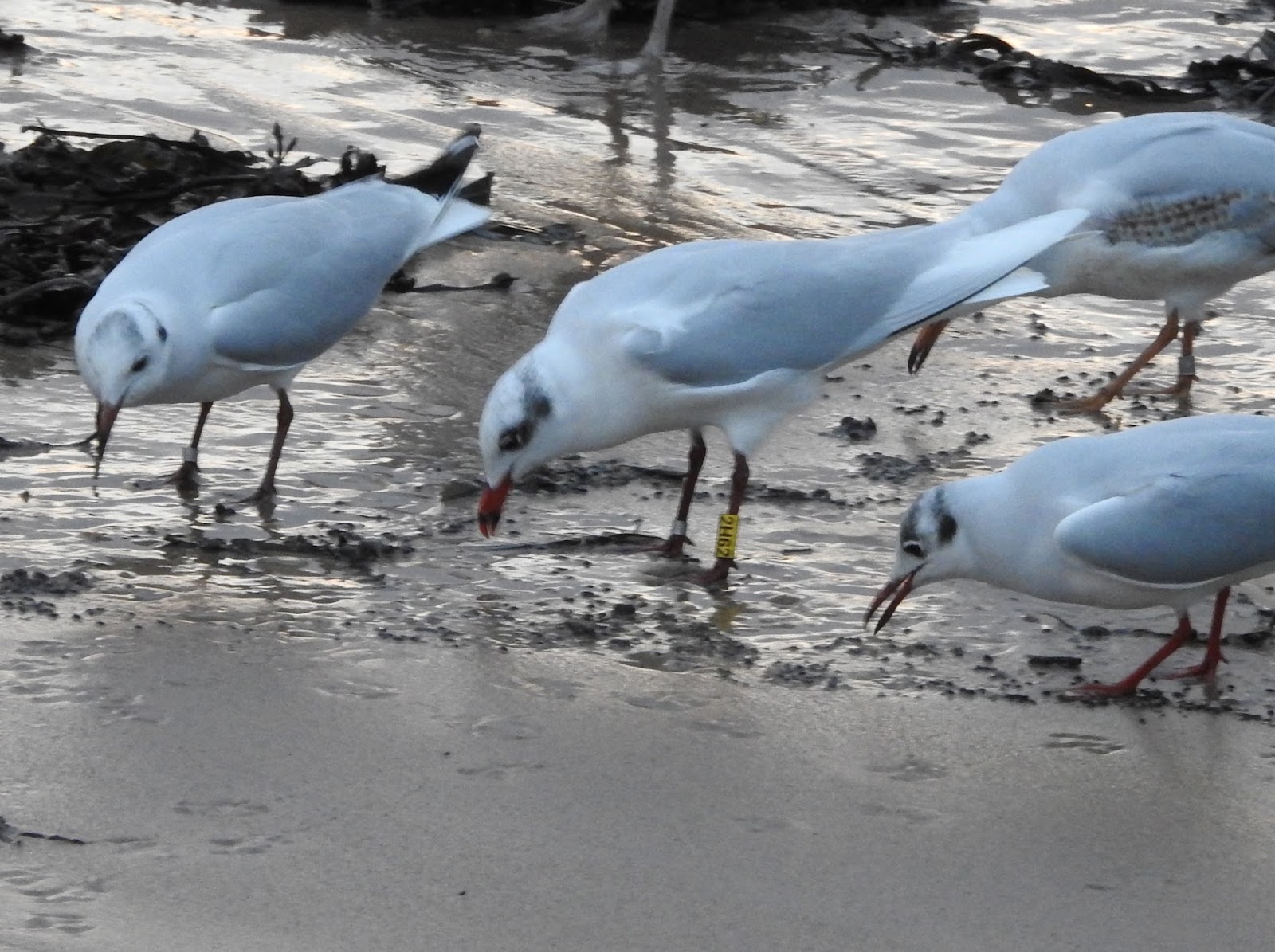
(L41 ringed Maletangen, Norway 12/09/2016 observed Newbiggin by the Sea 04/01/2017)


This bird has been reported more than 12 times, showing the usefulness of these rings.

(2H62, originally ringed at Great Yarmouth Beach (13/11/2013) and has wintered at Newbiggin every year since.


Metal rings are no longer of any real use (my opinion). Only useful if re-trapped. According to BTO figures less than 1% are re-trapped. (I assume many of the re-traps are controls giving little new info.)


Other considerations which need to be taken into account. There should not be a culture of 'Ringers Ticks', birds should not be paraded before the cameras (release them straight away) and on bigger projects you need more ringers present. (To fix flags, colour rings, transmitters etc. at least ten minutes per bird. If you catch 6 birds the last one ringed will have been in a bag/cage for an hour.)

I hold my hands up and admit that I saw my one and only Radde's Warbler because the ringer waited a short time for local birders to arrive.
A lot more local study work i.e. feeding patterns, breeding success could easily be achieved by putting in the hours with a pair of binoculars. I'm not sure much is achieved by constant effort sites and tape luring other than a raised stress level in the birds.

Finally I do believe some of the projects especially the Harrier and Cuckoo satellite tagging projects are helping us learn some valuable information.

My opinions only!